AI Productivity for SaaS Teams: Save 6 Hours a Week
Discover how small SaaS teams use AI to reclaim 6+ hours weekly, boost conversions, and compete with enterprise rivals — practical workflows included.
Practical AI ideas for founders and lean teams.
Discover how small SaaS teams use AI to reclaim 6+ hours weekly, boost conversions, and compete with enterprise rivals — practical workflows included.
Autonomous AI agents are not just automation tools — they are adaptable, decision-making collaborators that can reshape every layer of a small or medium business. This article explains practical applications, explains how agents deliver scalable commercial value, outlines common challenges, and offers a clear roadmap for entrepreneurs who want to pilot agent-driven workflows to future-proof their ventures.
AI agents—autonomous software that can perceive, decide, and act—are no longer niche experiments. For North American SMB retailers, they represent an accessible pathway to richer customer experiences and leaner operations. This article outlines practical applications, real-world benefits, and step-by-step actions entrepreneurs can take now to turn AI agents into competitive advantages.
Autonomous AI agents are moving beyond lab demos into practical tools that can transform how small and mid-sized businesses operate. This post explores their commercial potential—how they boost productivity, cut costs, and create strategic advantages—offers industry examples, outlines future trends, and raises the ethical trade-offs entrepreneurs must manage.
Autonomous AI agents are no longer sci‑fi — they're practical strategic assets that SMBs can use to cut costs, speed operations, and unlock new revenue. This article explains how AI agents improve operational efficiency, highlights industry-specific examples, outlines concrete ROI and risks, and gives a step‑by‑step adoption roadmap for North American small and midsize entrepreneurs ready to convert automation into competitive advantage.
Autonomous AI agents are moving beyond novelty to become practical tools for small and midsize businesses. By automating routine workflows, accelerating decision cycles, and enabling data-driven scaling, AI agents can cut costs, improve customer experience, and free teams to focus on strategy. This article outlines real-world applications, commercial advantages, and a step-by-step playbook for entrepreneurs who want to integrate AI agents responsibly and profitably.
Autonomous AI agents are shifting from experimental tools to commercial drivers for small and midsize businesses. This article explains how these agents improve efficiency, reduce costs, and accelerate innovation, and offers a step-by-step playbook SMB entrepreneurs can use to deploy them responsibly and capture measurable business value.
In 2024, AI agents have moved from experimental tools to commercially strategic assets for SMBs. Enabled by advances in multimodal models, real-time data pipelines, retrieval-augmented generation, and agent orchestration, these systems deliver personalized, proactive, and scalable customer experiences.
Autonomous AI agents — software that plans, decides, and acts across systems with minimal human intervention — are reshaping how small and mid-sized businesses operate. They reduce repetitive labor, accelerate decision cycles, and enable new business models from agent-as-a-service to hyper-personalized offerings. This article explains commercial impacts, industry examples, and concrete steps entrepreneurs can take to harness AI agents for cost savings and new revenue streams.
AI agents in the U.S. are rapidly evolving from experimental tools into autonomous business assets, driving a $1.6 billion market in 2024 projected to hit $13.5 billion by 2030. Entrepreneurs who treat agents as capital investments—owning workflows, creating multi-agent systems, and building new revenue models—gain strategic advantages.
- Explain why AI agents in 2025 represent a structural business inflection point, not just an efficiency tool. - Highlight the market data (adoption rates, ROI, growth projections) that shows AI agents have moved from pilots to core P&L drivers. - Distill the four major trends: multi-agent systems as an operating fabric, agents as revenue engines, agent-centric business design, and the new talent stack.
Highlight: the surge in U.S. AI investment and enterprise adoption, the shift from “AI features” to agent-native operating layers and workflows, the four main commercial archetypes for agents, and how real moats come from data, embedded workflows, governance, and community. Emphasize practical guidance for founders and investors on building predictable cash flows from agent capabilities.
AI agents in the U.S. have evolved from experimental tools into powerful revenue engines, fundamentally transforming startups and enterprises. The U.S. leads a rapidly growing market, projected to expand from $1.6 billion in 2024 to $13.5 billion by 2030, driven by agents orchestrating complex workflows in sales, finance, and customer service. While adoption is widespread—with 79% of organizations using AI agents—strategic integration lags, presenting vast commercial opportunity.
These autonomous software entities enhance customer experience, revenue operations, productivity, and enable new AI-native products, driving significant efficiency gains and cost savings. U.S. enterprises lead adoption, with strong investment momentum and growing focus on specialized, multi-agent platforms tailored to verticals like healthcare and finance.
The AI agent revolution is transforming U.S. entrepreneurship, with December 2025 marking a pivotal moment as adoption shifts from experimental to essential. PwC’s 2025 survey reveals 79% of U.S. firms already deploying AI agents, yet many treat them as tactical tools rather than catalysts for reinvention. The global AI agents market is booming, expected to soar from $5.1 billion in 2024 to $47.1 billion by 2030.
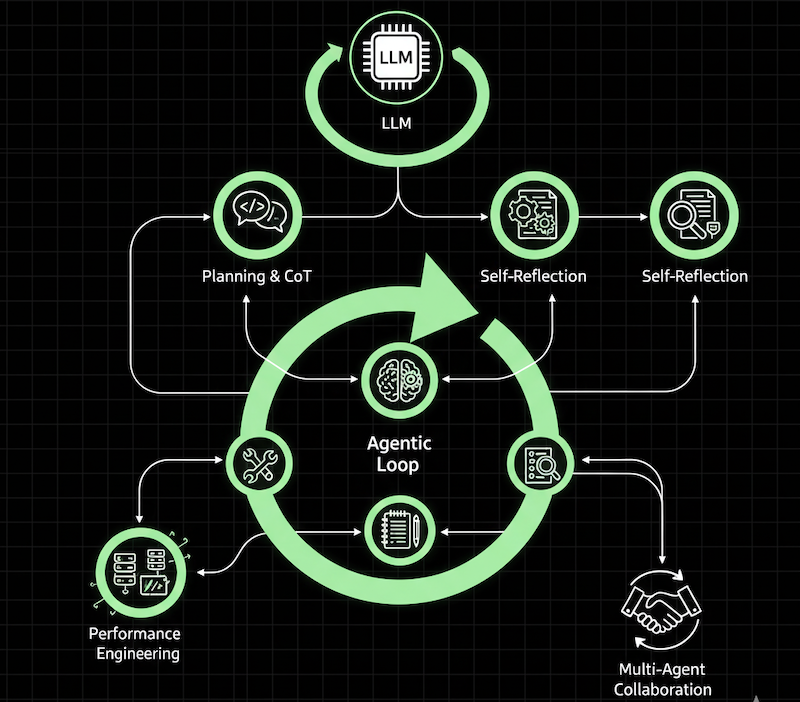
This article argues that the qualitative leap in AI Agent capability stems less from the raw intelligence of the Large Language Model (LLM) and more from the effective "cognitive workflow" designed around it. By contrasting a standard Chatbot’s static, one-shot generation with an Agent’s dynamic, iterative process, the piece establishes a crucial shift in AI application development.
Discover how AI automation can reduce costs and improve efficiency across various industries.
Learn practical strategies to implement AI-powered customer support.
A comprehensive comparison of popular no-code automation platforms.
Join founders getting practical AI execution tips.
We'll send your access details to this email
Processing...